
Using our BioResource
Our infrastructure is designed to streamline research, providing a better route to discovery.
Developed by researchers, for researchers, the NIHR BioResource offers access to over 350,000 recallable volunteers, with and without health conditions, ready to participate in health research. Single consent, single database, single repository.

What we offer researchers
We manage large cohorts of participants across rare diseases, common conditions and the general population, which enables precision recruitment of study participants based on genetic or clinical traits. This approach makes previously unfeasible studies possible, especially in rare or complex conditions.
How we make research more efficient
For a study into a genetic variant that occurs in approximately 1 in 10 people, researchers would typically need to recruit about 500 participants to find 50 with the variant of interest.
Working with the NIHR BioResource is more efficient: we can identify and invite them from our existing cohort, saving you time and resources. We screen data in advance, so only those who meet your study criteria are invited to take part.
Watch our short animation to understand the benefits and process of partnering with the BioResource to deliver your research
Resources for researchers
Find out more about the support we can provide to researchers from academia, industry and the NHS
-
Recall/Samples
Find out moreRecall by genotype/phenotype and stored samples including DNA (blood/saliva), plasma and serum.
-
Genetic and clinical data
Find out moreLearn about the data we have available and how to request access.
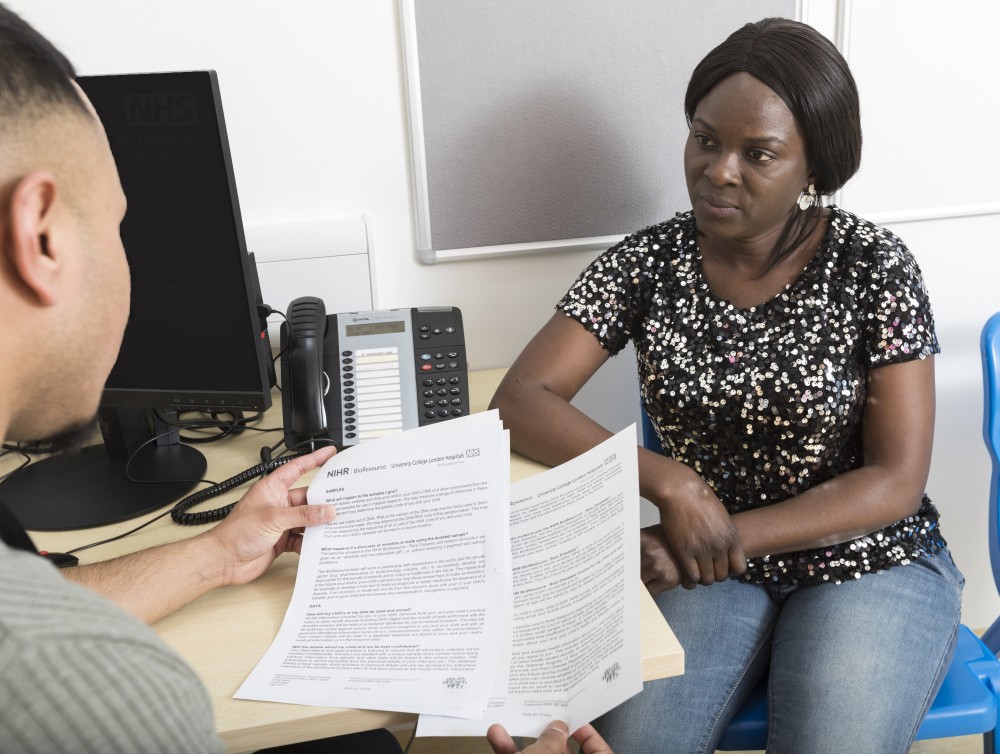
Participant cohorts
NIHR BioResource research participants are grouped into cohorts based on health conditions or demographic factors such as age or ethnicity. Researchers can access general health and lifestyle data, plus additional cohort-specific information.
Research supported by the BioResource
-

400+
active and completed studies delivered through the BioResource
-

500+
academic publications acknowledging the role of the BioResource
-

350,000+
consented BioResource participants available to participate in research
-
Studies
Find out moreView the full list of active and completed studies involving BioResource participant data, samples and recall to see examples of how to partner with us to deliver your study.
-
Publications
Find out moreResearchers acknowledge the BioResource and our participants in peer reviewed academic publications. View the full list of publications going back to 2009.
Frequently asked questions
Who can apply?
Researchers from academia, industry and the NHS are welcome to apply.
How long does the process take?
- Applications for both academic and industry studies are reviewed monthly
- Feedback is provided within 1–2 weeks of the Scientific Advisory Board review meeting
- Sample shipping: typically 3-5 months
- Recall studies: can begin once approvals are in place
What data do you have?
We hold genetic, clinical, lifestyle and metabolomic data. Find out more about available data.
What is recall?
Recall involves inviting BioResource participants to take part in a specific study. The requirements of the participant will vary, but examples include:
- providing fresh samples
- completing questionnaires or interviews
- undergoing assessments or screenings such as an MRI
BioResource participants consent to be contacted about recall studies, but each recall study requires an invitation to be sent containing all the required information. Additional consent must be taken from an eligible participant before they can take part.
Can you help me with my application?
Yes! Email us on nbr@bioresource.nihr.ac.uk
Testimonials
Hear from some of our research partners
-
Cell Type-Specific Roles Study
"The BioResource has been excellent in providing a general framework of recall by genotype study: full end to end partnership from providing support to help refine the research protocol to study design, advice on what can and can’t be done, and then the recall itself.
"Without the BioResource, there is no capacity to do this type of research at all. We would have to do work in mice or in cells or other model systems, thereby trying to mimic the biological condition in humans."
-
Inflammatory Bowel Disease Research
"I am so grateful to the team at the IBD BioResource, and the volunteers who took part, for enabling us to carry out my research.
"Using the information held by the IBD BioResource has helped us to target recruitment of patients from each of these groups – work that would otherwise have been time-consuming or impossible for us to do from our own patients at the trust."
-
RESTORE: Lab-Grown Red Blood Cells Trial
"In order to carry out the RESTORE study we needed to identify a population of highly phenotyped volunteers to match to our donor cohort.
"The BioResource provided the necessary infrastructure to enable this, not only with the phenotypic information of potential participants but because of the access it gave the RESTORE team to contact these volunteers and enable recruitment."
-
iPSC Reprogramming Study
"Our experience of working with the BioResource has been very positive. The team have been professional and friendly in their approach and attentive not only to the needs of the volunteers but also to our specific research requirements.
"This has enabled the successful generation of primary cell lines from all three donor donations."
-
Leber Hereditary Optic Neuropathy (LHON)
“We are very fortunate to have access to the Rare Disease BioResource in this country.
By capitalising on this unique resource, we are recruiting participants with genetic eyes diseases and using the latest technology to give us a clearer insight into how genetic changes can affect different parts of the eye and cause visual loss.”
-
Antibody Responses to AZD-1222 Immunisation
"Vaccines can provide protection against infection and disease through the production of pathogen-neutralizing antibodies. However, some people are less able to generate effective antibody responses upon immunization due to their genes.
"In this study, we used the NIHR COVID BioResource to access samples from healthy volunteers immunized with AZD-1222, to compare their antibody responses with those who have known genetic changes."
-
Cambridge Centre for Lung Infection
"I have passed on my appreciation (to Andres and the R&D leaders) of the BioResource's very efficient and professional systems, which have facilitated us getting samples over such a short time.
"I have enjoyed liaising with everyone at the BioResource and am very impressed with the efficiency and friendliness of the team."