
Severe Mental Illness Longitudinal Evaluation (SMILE) BioResource
The Severe Mental Illness Longitudinal Evaluation (SMILE) BioResource is a re-contactable resource of volunteers with severe mental illnesses.

About the SMILE BioResource
A collaboration led by the Mental Health Translational Research Collaboration Mission, the University of Oxford (Oxford Health Biomedical Research Centre) and the NIHR BioResource to investigate the causes of severe mental illness (SMI) and how best to develop new treatments.
The SMILE BioResource launched in November 2025 and will collect information from people with experience of SMI to provide a resource for researchers to investigate the risk of SMI, its symptoms and how to manage difficult side effects of medication that some people experience.
Severe mental illness is a term that includes mental health disorders such as:
People with SMI may experience short-term and long-term issues, and current medication and other treatments may not work well enough.
A longitudinal study means that participants are included in a study over a period of time, and that additional data may be collected from them. A benefit of longitudinal investigation is that researchers may be able to discover developments or changes in characteristics over time.
Key goals
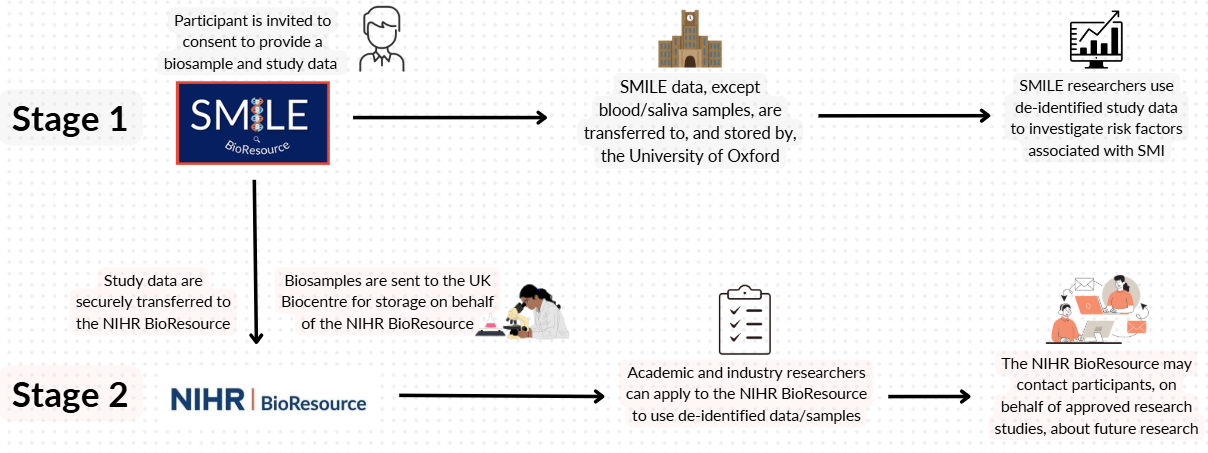
The SMILE BioResource is part of the NIHR BioResource, which includes hundreds of thousands of volunteers who wish to participate in health research, with and without health conditions. Volunteers joining the BioResource are asked to donate a small blood or saliva sample and to give consent to be invited to participate in health-related research based on data they have provided.
- The SMILE BioResource is seeking to recruit up to 2,000 study participants, aged 16 years or above, from across the UK who have a recorded diagnosis of SMI.
- We will continue to involve and engage SMI patients in the development of SMILE BioResource. A patient and public involvement engagement and participation panel (PPIEP) has provided feedback about how to design our study, and was involved in reviewing this webpage. PPIEP can ensure research reflects the priorities of those affected and that our language is accessible and appropriate.
- We aim to contribute to research studies that will result in scientific progress and improved treatment to benefit people living with SMI.
FAQs
1. Can I take a support person with me to the study appointment?
Yes, participants may bring a close relative or friend, care coordinator or peer support worker to the study visit for additional support.
2. Will my General Practitioner (GP) be informed of my participation?
No, unless a participant discloses that they intend to harm themselves. It is the duty of the personnel leading the study visit to pass this information on to a care provider (such as a secondary mental health team and/or GP) so that appropriate care can be put in place. Otherwise, participation in this study is completely separate from the care that you receive from your GP.
3. Will my taking part in the study be kept confidential?
All information collected will be handled according to strict ethical and legal standards to ensure safety and security, including but not limited to:
- Your personal details will never be shared without your consent, and samples will be labelled with unique numbers before laboratory testing
- Test results will only be used for research purposes, with genetic and health data stored securely and separately from personal details
- Only authorised BioResource members can access your personal information, and researchers may only use anonymised samples or data
- Researchers must apply for access, agree to strict conditions, and are prohibited from identifying you
- The University of Oxford and NIHR BioResource may securely request additional details from public bodies like the NHS and UK Health Security Agency
- Consent forms and identifiable records will be stored securely, with participant and sample IDs maintained to preserve necessary links
Find out more information about our safety and security best practices policies and how we keep your information safe.
4. What will happen to the samples I give?
Researchers aim to study how genes, made of DNA, influence health and disease by analysing DNA and other components from blood or saliva samples. All samples will be securely processed and stored, coded instead of named, though DNA can never be fully anonymous.
When released for a Stage 2 study (after participant consent), samples will be handled confidentially in a non-identifiable form, meaning they cannot be withdrawn afterward. Samples may be stored for up to ten years to allow approved research access and participant invitations to ethically approved future studies.
5. What will happen to the data I share?
The University of Oxford processes your information for research under the legal basis of serving the public interest. As the study sponsor, it is responsible for safeguarding and properly using your data. Information may come from medical, hospital, educational, social care, and disease registry records, and will be shared only with the NIHR BioResource and approved researchers. Identifiable details will be replaced with coded numbers, and all data will be stored securely with access limited to authorised personnel. Your information will be retained for up to ten years after the NIHR BioResource closes to support ongoing research objectives.
Your data may be shared outside the UK for health-related studies approved by the NIHR BioResource, but only the necessary information will be released. Efforts will be made to ensure you cannot be identified, though rare conditions may still pose a risk of identification. Approved researchers from public, charitable, commercial or pharmaceutical organisations may access the data under strict conditions.
Protections include:
- adequacy decisions for countries, meaning that we know their laws offer a similar level of protection to data protection laws in the UK
- UK-approved contracts
- requirements for strong security measures to prevent loss or unauthorised access
We also have strict procedures in place to handle suspected data breaches, with notifications provided to you and regulators when legally required.
6. What will happen if I don’t want to carry on with the study?
You can withdraw from the study and request that your data are removed at any point. If you choose to withdraw, you have two options:
- You can allow us to continue accessing your healthcare records (and any required social and educational records) from central NHS records, your hospital, your GP, school and/or research done with your sample. This is a ‘no further contact’ withdrawal.
- You can ask us to stop further use of your data and to destroy your remaining samples. Any research that has used your data or sample(s) cannot be undone. This is ‘no further use’ withdrawal.
Your personal information will be retained in an archive so that a record remains of your initial consent and the withdrawal process. If the SMILE BioResource/ NIHR BioResource is unable to confirm your decision, your sample(s) and data will be retained for future use, and you will not be contacted again.
You can withdraw from the study at any time.
Contact information
For further information about this study, please email the study project coordinator (smibioresource@psych.ox.ac.uk) or the Chief Investigator (rachel.upthegrove@psych.ox.ac.uk).
You can also contact the NIHR BioResource team with any queries on 0800 090 2233 or email: nbr@bioresource.nihr.ac.uk.